Counterintuitive Triumph
Defiance gets better press, but if you’re trying to change the world, obedience is smarter. It’s smarter because it’s easier; you can dig a canyon with spades and blasting powder, or you can channel a river through a gorge and watch the earth move. If you’re trying to redirect your life, defiance is spades and explosions but obedience is the river.
As we all know, change begins with one person (you)—and on the road to change it’s easier, ultimately, to obey Christ than to defy our ingrained vices. Of course, to obey Christ is to defy the world. But the issue is not one of mere semantics.
This is the idea behind verses like 1 Peter 1:14: “Behave like obedient children. Don't let your lives be controlled by your desires, as they used to be” (The Bible).
Peter, the friend of Jesus (subsequently his theologian), urges the disciples to defeat their habitual sins in a counterintuitive way—by obeying their Father. In effect, Peter is saying “Defy your old controlling passions; do it by obeying.”
Alcoholics Anonymous has picked up on this principle, but few of us have. We’d prefer to simply try and heroically buck the evil status quo, but this is just a sexy path to burnout. Rather, to obey Christ is the key to change, and therefore to freedom. We look at Christ and this overt act of obedience achieves the indirect end of defiance. In terms of breaking away from besetting sins, obeying is the most insolent act conceivable. To obey is to defy.
Such obedience, this compliance with a stronger will, leads to freedom. I can go out on the town and resist, one by one, greed, lust, drunkenness, pride, the lure of bright lights and sordid appetites…or I can simply obey my Father (“Stay with me,” he says) and the battle ends there, under his motive force.
As Jesus said, “If the Son sets you free, you will be free indeed” (John 8:36, The Bible). Living in Christ’s name is real freedom.
But obedience cannot be forced. That’s why most of us try assertive defiance first. I walk off on my own and pit my own desperate strength against each foe in turn—my “freedom” becomes a series of last-ditch fights with my habitual failures—which have become a pack of junkyard dogs.
There's a little wanna-be hero in us all. Thinking to assert our independence, we abandon one positive command—Stay with me—for a horde of negative injunctions, disconnected from the source of change. Don’t do that, you can’t go there, stay away from that, no, no!—we give the route of self-correction a spirited try. And the world applauds, even though we fail nine times out of ten.
All the while, God is waiting for us to obey the command that has already been spoken, and that would rescue us if we listened.
Sunday, August 07, 2005
To Obey or to Defy?

Saturday, August 06, 2005
Slow Day
I've been fighting the effects of a sinus headache today, with the typical side-effects. One of these is the tinkering syndrome: Doing little things of questionable importance to keep myself occupied. When I catch some kind of nagging flu-cold bug, the inspiration required for more serious endeavors is usually lacking.
On that note, here are a few buttons from some Photoshop tinkering.


I know you all have been just dying for some buttons, so feel free to steal 'em.
Glowing Fragments
What do you get when heaven and earth collide? 
::
Life often seems to me beautiful and incomplete. Mesmeric, but possessed with an air of absence. Lovely but broken.
G.K. Chesterton described the same thing when he said:According to Christianity, we were indeed the survivors of a wreck, the wreck of a golden ship that had gone down before the beginning of the world.
Accordingly, the fragments of this shipwreck are everywhere.
Relationships, for example, perpetually delight and disappoint, and often at the same time. They somehow manage to be both less and more than we expect.
The glorified icon of “career” is the same way. No matter how sweet your job, the evidence remains plentiful that you were intended for “more than this.”
Why do the pieces of our lives, when looked at closely, reveal a host of chips and cracks? As if we live in a mosaic world.
The way I see it, heaven and earth went head to head once, to cause all this debris. Earth and the angels flew in similar orbits until Adam and Eve gave God that first and most fatal cold shoulder. Then the world lurched in its orbit and the collision was inevitable—CRASH!—mangled Eden. Heaven did not give way for rebel earth.
But there was another “accident,” this one divinely initiated, and this time when the earth jolted from impact, all the previously broken pieces begin to glow faintly. Christ walked in the door and heaven shook the world again, and made all the fragments luminescent—charged with light.
Christ’s entry was a harbinger that the whole incandescent puzzle would be sorted out, mended.
So what do you get when heaven and earth collide? Glowing fragments.
The fragments are neither complete nor tragic. They’re simply not fixed yet.
That will change.
In the meantime, sunset glows while glass cracks underfoot.
Thursday, August 04, 2005
Short Story Slam
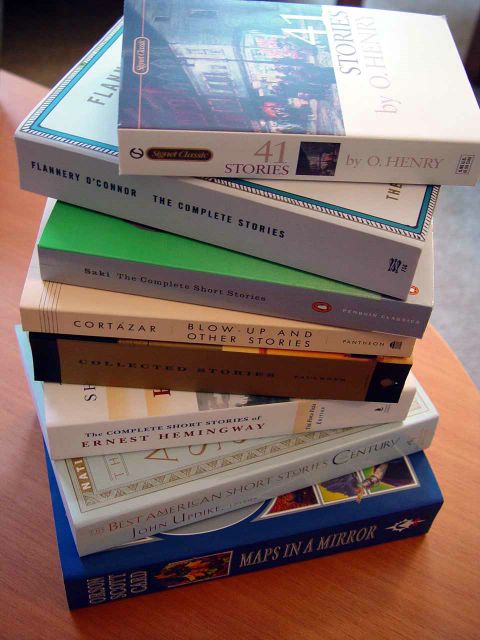
Yesterday Lindsay and I held our first apartment-wide Short Story Slam.
Drawing from the bookshelves located a strategic intervals throughout our downtown loft, we transported a number of chosen authors to a living room staging area and dug in.
The scheme was simple. After a preliminary “warm-up” period, during which we each read several stories of our choosing, we entered the Slam proper. Lindsay “assigned” me a story she had just read: I consumed “The Wild Plums” by Grace Stone Coates as she continued her independent explorations. Then we discussed.
Then it was my turn. I made Lindsay read Julio Cortazar’s “The Distances” while I forged ahead. And so it went: alternating assignments, which the other reader continued to accumulate new material, the sessions punctuated by brief discussion.
In a word, delicious.
Wednesday, August 03, 2005
A Little More Death, A Little More Life
I’ve been thinking recently about aging. Undeniably it’s bittersweet, and even I can testify to that. You get older and you get wiser—but you also get more brittle and you lose hair. With age comes experience, but experience has a bitter edge. And while one may gain a greater love for beauty, one may also come to possess less of it. All things considered, most would agree: It seems better to be young.
Aging and death are mysterious entities, and we fight them at the deepest levels. They seem alien and out of place. We find ourselves asking why they exist at all.
But if we make this query, there’s another we must make as well. Why does eternal life exist? (If we scoff at the reality, we must at least admit the concept—people have been talking as if it’s real forever.) The two live side by side: this aging, “living death,” in Augustine’s words, and this incorrigible perfection, eternal life. Why does eternal life exist? Although the answer defies us, this is one of those cases where the truth, as near as we may come to it, is a prior question.
Question: Why does eternal life exist?
Answer: Why does aging exist?
The problem, aging, precedes the miracle, eternal life; and if we knew what preceded the problem, we would comprehend the whole relationship perfectly. Instead, we can only hazard guesses.
Heaven is ageless, but I suspect agelessness there will be young—because death is an anomaly, and we all know this fact instinctively. In heaven, we’ll find the wisdom “of age” seated in the energy and beauty “of youth.” And what is more, we’ll look “like ourselves.” Puzzling.
In the end, we can age gracefully because of a graceful God who’s taken the sting out of death. In Christ, we know that each new wrinkle, each inch coming off the vertical,* will be one more cause for joy later on. When aging is permanently revoked, and instantaneous renewal sets in, we’ll laugh death in the face. If we’re wise, we’ll start laughing now.
In this sense, aging can be defined: In Christ, a little more death today is a little more life forever. There’s nothing age can do that heaven won’t renew with advantages.
Not so if we idolize transient beauty. In a wry reversal, Hollywood’s beauticians are really her morticians. If our hopes are for this life only, aging deserves all the horror we can muster.
* As in a basketball game. But you should really know that.
Tuesday, August 02, 2005
Happy Misery
Light from a Hidden Sun
In a way, what strikes you about Saint Peter’s words to a bunch of exiled disciples is something he doesn’t even say. Something glaring in its absence.
He writes about their bright future—a future dramatically altered because of Christ—and then notes, “In this you rejoice, though now for a little while, if necessary, you have been grieved by various trials” (1 Peter 1:6, The Bible).
Celebrating in the middle of unfounded suffering has always been a Christian trademark. At the time Peter wrote, his friend Stephen had already been stoned to death, “his face like an angel” (Acts 6:15). Paul and Silas had been beaten and thrown in jail—where they commenced to sing rousing praise songs. Later (Acts 26:29), Paul would display an unquenchable sense of humor en route to his execution in Rome. Peter himself would prove irrepressible at the moment of his death. These, and other episodes, quickly set the standard of “happy Christian misery.”
This being the case, Peter might have been expected to try and guard the paradigm. Keep it safe, this treasured legacy. We almost expect him to nudge these exiled friends down the proper path: Hey guys! Psssst. Little tip for ya. We have this tradition, uh…when you’re getting shot down right and left, treated like dirt, physically attacked…um, SMILE. Just so you know. A little thing we do…
Instead, Peter merely remarks that the tradition is still going strong. “In this you rejoice,” he observes. Rejoicing is the obvious fact, “various trials” the extenuating condition. These exploited refugees are living out a strangely bright reality.
In a way, I’m mystified. It’s as G.K. Chesterton wrote:“Joy, which was the small publicity of the pagan, is the gigantic secret of the Christian.”
I guess most of us are at least a little pagan. As for me, I own this “gigantic secret,” comprehend it partially anyhow, but I’ve called upon the services of the “small publicity” department too. Clearly, there is a paradoxical way in which undeserved suffering changes from something to be sworn at to something in which we sing. Why? Here is the clincher.
Ridiculous, unfounded trials—encountered for the sake of Christ—are a sign of favor. Peter and Paul, both eventual martyrs, were clear on this point. God uses “various trials” as a way of testing his people—“testing” them in the old-fashioned way (as opposed to the modern way, which is perpetrated by students upon their teachers). God’s testing proves us, shows us what we’re made of, nudges us, shoves us, spurs us, burns us—until the spiritual gold at our cores begins to gleam through. We may not realize that the gold is there, but God knows, because he buried it.
To distil it in one strange fact: Affliction for Christ is grace. God mercifully doesn’t take suffering away until we have been adequately changed by it. We are given a point of decision, a crucible to form our faith, a moment to say a vital Yes to Christ. And on top of that, another factor is in play. Call it Glory.
After his initial observation, Peter’s next breath adds luster to the believers’ strange situation: “…you have been grieved by various trials so that the tested genuineness of your faith—more precious than gold that perishes though it is tested by fire—may be found to result in praise and glory and honor at the revelation of Jesus Christ” (1 Peter 1:7).
"Tested genuineness” is one thing. “Praise and glory and honor” is something else, something directly related but different. If proven character is indeed its own reward, this glory is pure gratis. Somehow, Christ is awarding it to us apropos our “testedness.”
As I see it, this is a kind of divine double-bonus. The most unfair ridicule or abuse I could conceivably experience would, in Christ’s economy, have a purifying effect inside me; and all the while AJ the human was being refined and enhanced, I would be accumulating glory.
Suffering for Jesus may hurt, but it makes us bigger and better—makes us the kind of creatures who can live in the vivid, heavy world of heaven, able to breathe the rarest air anyone ever can. And all the while we grow in this way, glory is accruing. Christ’s favor is piling up, and we’re growing strong enough to bear its weight. Happy misery.
At this point, we ought to pause and catalogue our paradoxes so that none of them escape.
- In 1 Peter: The disciples instinctively celebrated in their pain.
- This fact was obvious to onlookers.
- Suffering, while undeniably present, got a low billing.
- After all, it could only “improve” the believers.
- And glory was on the table.
- They could “win” it; we can too.
- Christ will award glory to us.
- Christ will praise us.
It seems almost impossible—from the startling surface fact to the mind-bending conclusion. Somehow, Jesus commending us will point up the invincible power of his glory all the more. He will praise us, and we’ll reflect the power of his own person back. Perhaps the impossibility of this theme, top to bottom, has helped to keep it, in pagan minds (and therefore many of ours)—a “gigantic secret.”
What is left to say?
As Peter summarized, “Though you have not seen [Christ], you love him. Though you do not now see him, you believe in him and rejoice with joy that is inexpressible and filled with glory” (1 Peter 1:8).
The “glorified joy” is what I’m after, the kind that lasts. Delight kindled by close proximity to the source of all glory. Joy infused by Christ’s light, which catches us in its beams, radiating outward, rays in the true sense, repercussions extending infinitely. Glory for now and later.
We cannot say what its final end will be, for in fact there will be no final end, only progressive stages of a story. In the end, perhaps all we can really say is that the story is Christ’s—and therefore worth any price to get into.
In view of this story, happy misery hums with logic. Suffering casts flimsy shadows, and one sees why the dying disciples smiled. They had a hidden sun in view.
Rarities
Anyone who blogs around much (yes, that's a verbal phrase) ends up running into a lot of so-called poetry. Most of it is awful. Much of it, in fact, for reasons too numerous to be named here, makes you feel slightly queasy...or evokes a vague sense of pity.
That's why a blogger who can make a legitimate claim to the title of "poet" deserves recognition.
Check out these pieces from Anonymouse. I think of this collection as "Cathedral poems," an idea I took mostly from "Shhh...." and "Our Lady of Perpetual Springtime."
Do yourself a favor and read them slowly.
Monday, August 01, 2005
Saint Augustine's Childhood - Garry Wills, A+
Augustine the Kid
Saint Augustine's Childhood - Garry Wills 
How does one “review” Augustine? In short, one doesn’t—seventeen-hundred years of history already have. It’s not a question of whether his writings are relevant today, but how many hours you’ll dedicate to reading them. Like Henry James or Shakespeare, Augustine’s brilliance is in effect timeless. This review, as a result, focuses not so much on Augustine’s thought (which justifies books) but on one translation.
I’d wanted to read The Confessions for years, and prior to jumping in, I felt compelled to evaluate the translations available. One thing emerged quickly: In terms of clout and immediacy, Will’s work was getting the buzz. I bit.
Now having read Wills’ first installment of “The Testimony,” as he translates Augustine’s title, I’m ready to add my vote to the New York Review’s take: “his translations…sizzle.” Childhood, as communicated and contextualized by Wills, flows smoothly, and the main streams of Augustine’s thought are exposed clearly. Wills’ introduction, annotations and commentary are perceptive, and thoroughly documented with complementary texts from the saint’s other writings; at the get-go, Wills' identification of The Confessions as a long, devotional prayer is enlightening—and other comments are similarly insightful.
To sum up, Wills has put in the time—extensive language work and Augustinian research (including a Penguin Famous Lives biography)—to make his translation the hands-down winner. Wills is a sterling frame for one of history’s keenest minds.
Cabbages & Questions
I just ran into this post from Little Cabbages via the (increasingly popular) VRP website. She smoothly quotes C.S. Lewis, and playfully mentions anthropomorphism--and for these accomplishments alone she deserves some recognition.
And since I never post stand-alone links without a disclaimer, here it is:
I virtually never publish stand alone links, but LC's thoughts re: "Is yellow square or round?" really deserve a read.
Go try some cabbage.
Victory!
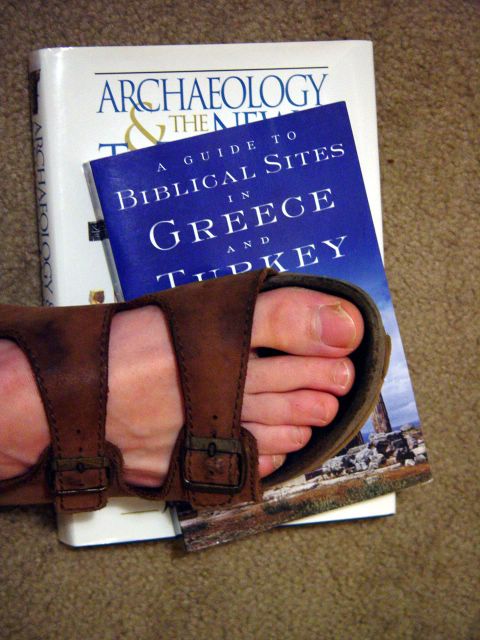
In the Greco-Roman world, victory was demonstrated by placing one’s foot on the neck (or spine, if the enemy had no neck) of the vanquished foe.
Sunday afternoon, after a period of combat lasting almost two months, a bitter struggle came to an end.
I decisively drove a final paragraph through the jugular of my Ancient Philippi research paper, slashed my “Ten Archaeology Site Reviews” project to the heart with a concluding critique, brutally speed-read the remaining 50 pages of my 600+ page allotment…and dismissively send the assignments to their maker.
It is over. The end-game was bloody, but now at last I can sheathe my battle-worn sword and return to the homestead, where provincial challenges of my own devising await.
 or
or 







1 comments:
Post a Comment