
The obligatory shot.
Wednesday, July 28, 2004


The Dueling Oak
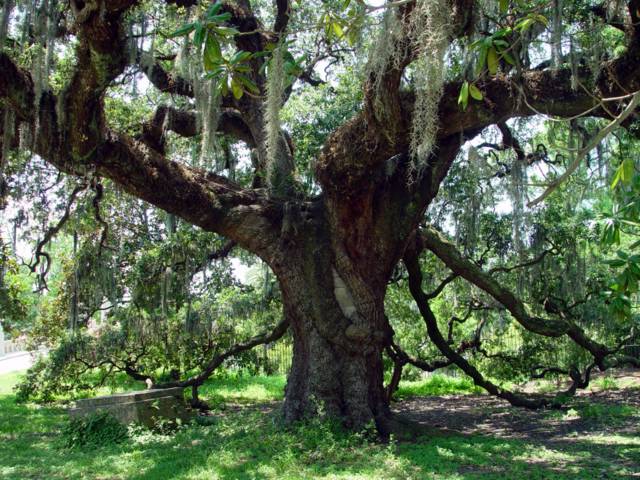
It's not every day you walk on ground that's soaked with century-old blood. City Park, New Orleans.
New Orleans Public Cemetery # 1

Due to low water levels, above-ground crypts are the norm. Family burials aren't unusual... A fitting end to the New Orleans travelogue.
Monday, July 26, 2004
Atlas Mugged
Ayn Rand, Someone Who Got Part of the Picture
So I finally finished Atlas Shrugged. It took two months, lots of coffee, and numerous notes scribbled in the margins, but at last I’ve completed Ayn Rand’s epic. As you may know, the book was number one on the “Top 100” list compiled by Modern Library’s readers in 1998. (Atlas did not make the “official” list compiled by Modern Library’s board, but you can’t have it all.)
In the past, Atlas Shrugged came up frequently enough in conversations for me to consider reading it, even though the book weighs in at 1069 pages in my small paperback edition and will never appear on a “beach reads” list. But I always like to know what the opposition has to say.
I finished the book yesterday, sitting in the Houston terminal on my way home from New Orleans, and now I’m a little uncertain how to articulate my response. Partly because my feelings are mixed. Suffice to say this won’t be a book review. (And if you're not familiar with the book, this may leave you a little lost...)
Was it bittersweet? I certainly found the book bittersweet, which is to say I found glimpses of glory, clues to reality as Christ intends it. “Wyatt’s Torch,” Hank Rearden’s self-defeating struggle for joy, Eddie Willers’ helpless aloneness—such elements convey a sense of what it means to be a created human, struggling for happiness amidst earth’s ruins. However, most lessons were negative, as in “that’s not quite the way things are,” since the biggest piece of the puzzle was missing. But the resemblance to reality was near enough to shed light on life. As in…
Paradise on earth? For me, the “Gult’s Gulch” segment reflected the unadulterated, super-reality of heaven. (No doubt Rand was making implications about “heaven,” but I didn’t take them as she intended.) Dagny Taggert plummets through the clouds in her plane and “awakes” to discover her perfect lover, fulfilling labor, brilliant company, perfectly-suited dwellings, unfading rewards, and joy in every detail of existence, even grocery shopping. This sounds a lot like the heaven I anticipate, the pictures evoked obliquely by Christ. But Rand was an atheist.
As John Piper writes:
So I finally finished Atlas Shrugged. It took two months, lots of coffee, and numerous notes scribbled in the margins, but at last I’ve completed Ayn Rand’s epic. As you may know, the book was number one on the “Top 100” list compiled by Modern Library’s readers in 1998. (Atlas did not make the “official” list compiled by Modern Library’s board, but you can’t have it all.)

Perfectly adapted to their environment, Modern Library Classics are nearly invisible to the casual viewer.
A quick aside: I personally love the classics editions Modern Library publishes. The cover designs and the prefaces by living authors have won me over, and we have quite a few copper-colored books on our shelves. So many, in fact, that it’s helpful for camouflage purposes; when I acquire a new M.L. classic, Lindsay doesn’t notice for weeks, if at all. But back to Ayn Rand.
In the past, Atlas Shrugged came up frequently enough in conversations for me to consider reading it, even though the book weighs in at 1069 pages in my small paperback edition and will never appear on a “beach reads” list. But I always like to know what the opposition has to say.
I finished the book yesterday, sitting in the Houston terminal on my way home from New Orleans, and now I’m a little uncertain how to articulate my response. Partly because my feelings are mixed. Suffice to say this won’t be a book review. (And if you're not familiar with the book, this may leave you a little lost...)
Was it bittersweet? I certainly found the book bittersweet, which is to say I found glimpses of glory, clues to reality as Christ intends it. “Wyatt’s Torch,” Hank Rearden’s self-defeating struggle for joy, Eddie Willers’ helpless aloneness—such elements convey a sense of what it means to be a created human, struggling for happiness amidst earth’s ruins. However, most lessons were negative, as in “that’s not quite the way things are,” since the biggest piece of the puzzle was missing. But the resemblance to reality was near enough to shed light on life. As in…
Paradise on earth? For me, the “Gult’s Gulch” segment reflected the unadulterated, super-reality of heaven. (No doubt Rand was making implications about “heaven,” but I didn’t take them as she intended.) Dagny Taggert plummets through the clouds in her plane and “awakes” to discover her perfect lover, fulfilling labor, brilliant company, perfectly-suited dwellings, unfading rewards, and joy in every detail of existence, even grocery shopping. This sounds a lot like the heaven I anticipate, the pictures evoked obliquely by Christ. But Rand was an atheist.
As John Piper writes:
Ayn Rand equated [duty-driven morality] with Christianity and rejected the whole thing out of hand. But this is not Christianity! It was tragic for her and it is tragic for the church that this notion pervades the air of Christendom—the notion that the pursuit of joy is submoral if not immoral. (Desiring God, Multnomah Publishers, © 1986)
Rand’s philosophy, or “theosophy,” since she clearly sought a God-substitute, would indeed be fitting in a world where God was a controlling tyrant, an impersonal essence or nonexistent (Islam, Hinduism, Buddhism). But alas. Hoping for a Godward impulse in Rand was as vain as hoping to find one in…
Her characters. Atlas’ protagonists are fiercely idealistic and stronger than anyone in the real world. When Hank Rearden gives up his one true love, tears came to my eyes, but not to his. Nonetheless, Rand uses her industrial heroes so adeptly that they are a testimony to the breadth of her vision rather than her lack of common touch. Rand didn’t know it, but the archetypes for her protagonists, the death defying “prime movers” peopling her novel, can be traced back to the likes of Abraham, Moses, Noah, Elijah, all the way to Christ. These “men of whom the world was not worthy” defied societies and nations to stand the earth on its head. But apparently she missed that connection.
And ultimately, that’s the final word on Atlas Shrugged: connections missed. Rand got one crucial thing right—our pursuit of pleasure and joy, the best we can find, should be unabashed. But the book is bittersweet because she clearly didn’t get it all. Her hedonism took the form of dynamic sexuality and fulfilling work, but the gifts stumbled her up, and she never saw clear to the Giver. As her characters repeatedly say, “There are no contradictions; check your premises.” When it came to the existence of God, and the nature of pleasure, one wishes she had.
Her characters. Atlas’ protagonists are fiercely idealistic and stronger than anyone in the real world. When Hank Rearden gives up his one true love, tears came to my eyes, but not to his. Nonetheless, Rand uses her industrial heroes so adeptly that they are a testimony to the breadth of her vision rather than her lack of common touch. Rand didn’t know it, but the archetypes for her protagonists, the death defying “prime movers” peopling her novel, can be traced back to the likes of Abraham, Moses, Noah, Elijah, all the way to Christ. These “men of whom the world was not worthy” defied societies and nations to stand the earth on its head. But apparently she missed that connection.
And ultimately, that’s the final word on Atlas Shrugged: connections missed. Rand got one crucial thing right—our pursuit of pleasure and joy, the best we can find, should be unabashed. But the book is bittersweet because she clearly didn’t get it all. Her hedonism took the form of dynamic sexuality and fulfilling work, but the gifts stumbled her up, and she never saw clear to the Giver. As her characters repeatedly say, “There are no contradictions; check your premises.” When it came to the existence of God, and the nature of pleasure, one wishes she had.
Filed in: Books Philosophy
Sunday, July 25, 2004
The Terms of Bittersweetness
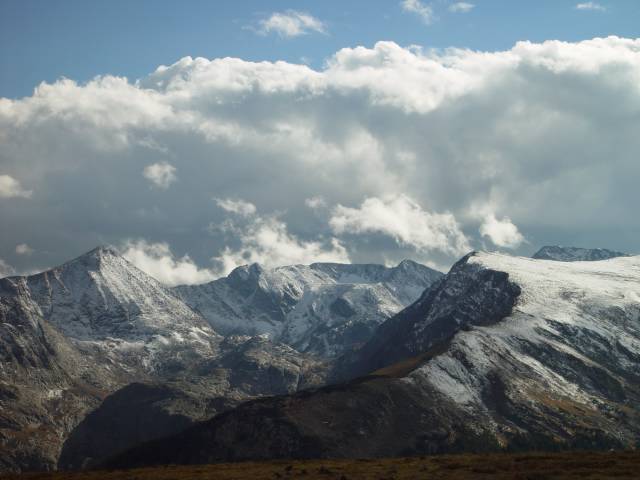
Mountains are bittersweet. © 2004 Ariel Vanderhorst
An Explananation for the Confused and Curious
When I say the word “bittersweet,” clouds of associations come to mind. But I’ve thought about life in these terms for awhile, and since vague ambiguity isn’t the tone I’m after (no, really), I see a need for definition. BitterSweetness. Let’s consider it in terms of denotation and connotation. First, the denotation, or “literal” definition: Bittersweetness is mingled joy and longing, pain shot with pleasure, earthbound wistfulness fueled by heaven—an elusive, paradoxical feeling.
Now for the connotative side, our “free associations.” For me, “bittersweetness” conjures up pictures—aspen leaves, sunsets (and their connotations), places—Long’s Peak, Colorado, a path through the woods I used to run on, concepts—“inconsolable longings,” tearful joy, and even moments—an interlude with a book and coffee, praying alone outside… Almost anything that gives me happiness while charging my soul with a desire for more, something greater, higher, beyond what I am enjoying. This feeling of joy just barely tasted, of a vision just brushed at, is the heart of bittersweetness.
To clarify, consider the ubiquitous word “cool.” (The most widely used word in our language?) Denotatively, we might say it means “frigid” or “hip” (or, like, whatever). But connotatively, we can’t begin to catalogue all the contexts in which the word is applied. The trip was cool. The surgery was scary, but all cool. We finally broke up, but we’re both cool with it. You missed a jump shot? Don’t worry about it, you’re cool. You’ll make the party? Cool. You can’t come? That’s cool. Hey, cool shirt. Cool sauna.
Likewise, in many ways, bittersweetness is in the eye of the beholder. It varies according to the viewer’s maturity and powers of perception. But however wide the personal associations, bittersweetness always has explicit denotations. So when I say, “Mountains are bittersweet,” I’m saying, “Mountains are thrilling because they’re in some ways as close to heaven as we can now climb…” My point being, “bittersweet” is a specific adjective. Don’t equate it with “cool.”
Life experience reveals there are some things which are invariably not bittersweet. They provoke no Christward longing, give no hint of heaven’s joy, no clue that we have souls. Regarded in their true light, these are the things which Christians should tend to despise. If something (I don’t say “someone”) offers us no trace of heaven or Christ, of authentic joy, however hidden, fallen or forgotten, it is evil indeed.
Saturday, July 10, 2004

Grand Canyon Fixation?
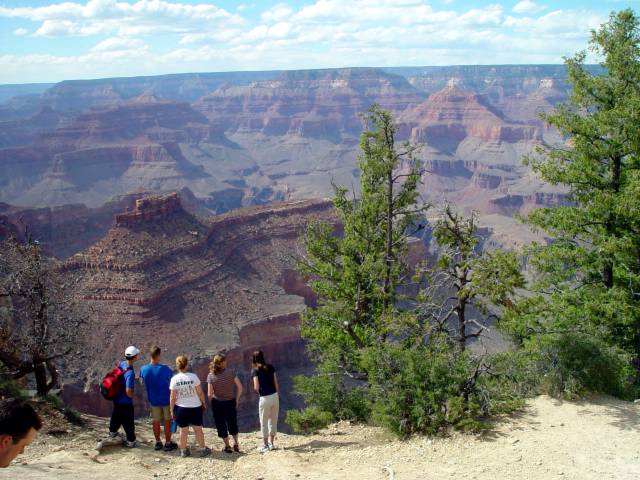
© 2004 Arielinds Photography
In the third week of May ‘04, we took a group of college-age friends to the Grand Canyon. Our stated goal was to build friendships in a setting where Christ’s glory made regular appearances, so striking you could hardly miss it. We wanted to catch a vision for Jesus’ glory, and we did. But the greater challenge was to take that vision home, and keep pursuing it in our Kansas City, MO locale. We had to swap the clifftop experience for muddy lowland and still find wonder. Glory in the grind.
Below you’ll find a short photo documentary of that trip, mostly posted for fun, and with no real explanations—other than rather juvenile titles and captions that may be mildly amusing if you weren’t there. But there is something BitterSweet about all this. And while bittersweetness is better shown (grasped intuitively at first) than told (“figured out” mentally), and I try to keep categorical statements to a minimum, some explanation is called for. But, as usual, it will be truth told “slant.”
Tell all the Truth but tell it slant—
Success in Circuit lies
Too bright for our infirm Delight
The Truth's superb surprise.
Sociopath though she was, Emily Dickinson was on to something here. So here’s a slim line on Grand Canyon bittersweetness:
Beyond the Canyon
May 25, 2004
I survey the Grand Canyon,
out and over and in,
the earth rolled back,
the earth pushed aside.
I see it all clearly,
what I’ve never seen before.
An undying longing wells inside me,
and I enter the Canyon,
descend through its layers,
soak in sun and wind and water,
all the eye can see,
and I walk back up.
But I still haven’t found
the source of my bittersweet pangs,
the well of hope in my heart.
The Canyon makes it spring up and run out,
but it’s not in the Canyon.
So where does it spring from?
What did I hope to see?
What did I hope to find?
How will I be satisfied?
Job: “Behold, these are but the fringes of His ways…how faint a word we hear of Him.”
Filed in: Beauty Bittersweetness Creation Clues Poetry
Subscribe to:
 or
or 
or








0 comments:
Post a Comment